
Support those who protect us

We call on Ottawa to honour the service of our veterans and ensure that sensitive national security requirements are met adequately now, while options are assessed, and in the future.

For more than 80 years, Commissionaires has met Canada’s security needs while providing meaningful employment for veterans, enabling them to continue serving Canada after their uniform comes off.

On March 31, 2027, the federal government plans to end the preferred supply arrangement that has supported this mission without a clear veteran-employment arrangement in its replacement.

Canadian veterans deserve confidence that their jobs will remain secure. Help us urge Ottawa to build a better model that commits to veteran employment before ending the arrangement that does.

A smiling Commissionaires officer with service ribbons sits at his desk under a Canadian flag display

Our supply arrangement ends March 31, 2027

139 days left

  • Veteran employment.
  • Sovereign security.
  • True value for taxpayers.
Demand action

We create veterans’ employment

They served Canada. They still do.

Commissionaires provides a pathway for veterans of the Canadian Armed Forces to continue serving our country even after their uniform comes off. Veterans bring experience, discipline, and a sense of duty and purpose to civilian work that protects people, communities, and sovereign assets.

From guard to CEO, Commissionaires employs 3,500 veterans providing them with camaraderie and purpose.

A smiling Commissionaires member in dress uniform and white gloves outside a public building

Figures

employees nationwide
22,000
veterans
3,500
government client satisfaction
86%

Our supply arrangement ends March 31, 2027

139 days left

  • Veteran employment.
  • Sovereign security.
  • True value for taxpayers.
Demand action

What’s changing

The government will still need security. Canadian veterans must remain part of the solution.

Today

Right of First Refusal (RFR)

The current policy requires the federal government to approach Commissionaires before seeking guarding services from another supplier. Known as the Right of First Refusal policy for guard services, this arrangement links a government need with meaningful employment for veterans, ensuring sovereign security while delivering value for taxpayers.

Veteran employment built in

Starting in 2027

Replacement supply arrangement

Ending the RFR removes the government’s explicit commitment to veteran employment. It also decentralizes procurement and contract management, creating additional costs.

While Commissionaires can still bid, the replacement procurement model contains no veteran-employment evaluation criteria or requirement for Canadian ownership free of foreign influence.

No veteran employment measure

Ottawa must demonstrate what Canada gains before dismantling what this arrangement successfully delivers.

Our campaign demands

Build the better model first.

We demand Ottawa commit to veteran employment and strengthen a proven Canadian sovereign security capability.

  1. Pause irreversible implementation.

    We call on Ottawa to honour the service of our veterans and ensure that sensitive national security requirements are met adequately now, while options are assessed, and in the future.

  2. Publish the qualitative and quantitative rationale.

    We call on Ottawa to publish the veteran-employment, sovereign-security, and full-cost evidence behind its decision.

  3. Modernize with measurable commitments.

    We call on Ottawa to work with Commissionaires and affected stakeholders to build a modernized model that scores bids on veteran employment, not-for-profit status, life-cycle costs, and Canadian ownership and control, and that formalizes these commitments in enforceable contracts.

The Commissionaires advantage

A national security partner with a social mission.

A smiling Commissionaires officer stands beside a marked Commissionaires pickup truck outside a modern building

Not-for-profit by design

As Canada’s only national not-for-profit security company, we are not motivated by an insatiable appetite for profits, paying dividends to shareholders, or increasing the value of our company. We are proud to provide better wages, benefits and training, and direct a share of our surpluses to veteran causes. Our model puts employees and our social mandate at the core of our work.

Experience where it matters

We bring skilled, security-cleared professionals who know the sites they protect, have established working relationships, and are prepared to respond when it matters.

National reach. Public value.

Eighty-five per cent of our revenues go to our employees in the form of wages, training, and benefit programs. Our commitment to military, veteran, and first responder communities is evident through our philanthropy for these and other community causes.

Security beyond price

We tailor security services to each site’s requirements, recognizing that guard services are part of the first layer of defence at federal facilities. Choosing the lowest-cost bid often leads to high turnover, which creates security, training, clearance, and continuity risks at affected sites.

Protecting Canadians

Security depends on the people who know the site.

When a real crisis hits, who would you rather have by your side: a trained veteran or someone who has never faced one?

We provide:

  • Veteran employment
  • Sovereign security
  • Taxpayer value
  • Institutional knowledge
  • Training
  • Emergency coverage
  • Security clearance
  • Supervision
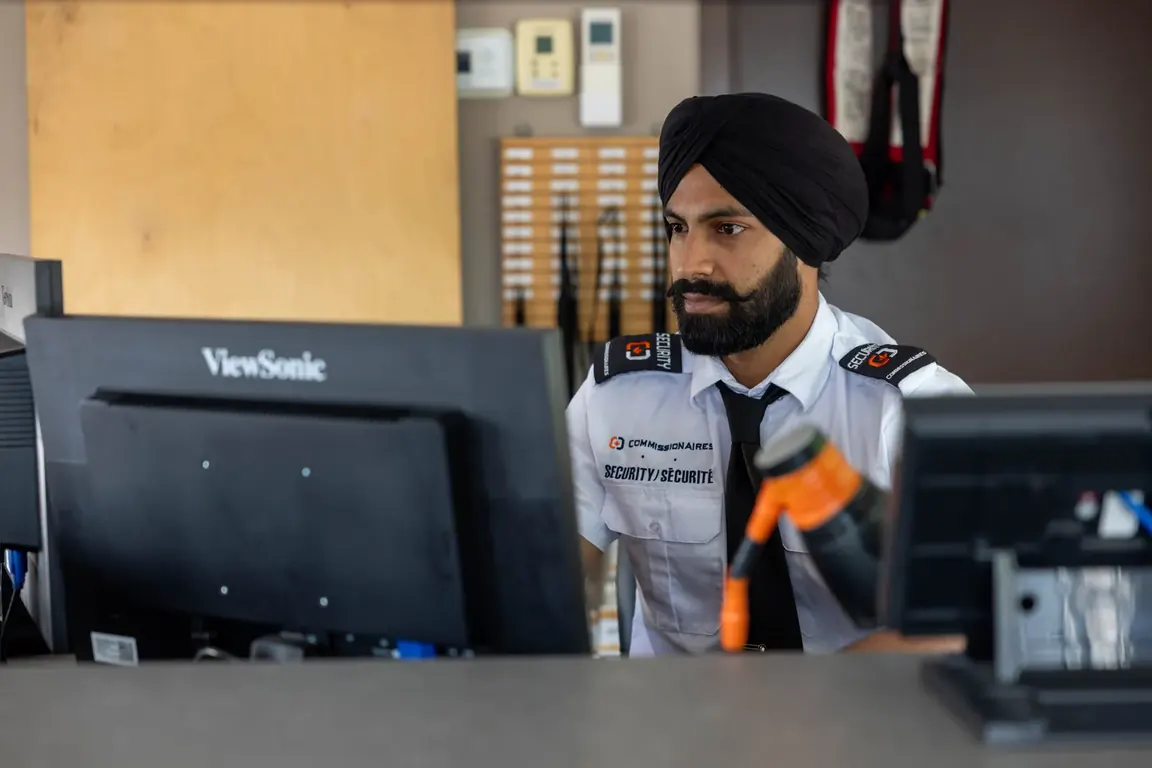
A Commissionaires officer monitors screens at a building security desk

Let’s clear a few things up

  • Yes. Employing Canadians is not the same as Canadian ownership and control. Ownership determines where strategic decisions are made, where revenues flow and whose interests guide corporate priorities. When protecting sensitive federal facilities and critical national infrastructure, those distinctions matter. Procurement should consider foreign government relationships and apply Buy Canadian principles to security services. Sovereignty, trust, accountability and Canadian interests must carry weight alongside price.

  • Sticker price matters, though it does not tell the whole story. Wage rates that ensure a consistent team, training, staff retention, transition costs and reliable service all impact the final cost. Procurement should account for that in full value.

  • The Right of First Refusal for guard services policy solves many significant challenges:

    • Formalizes a measurable government commitment to veteran employment.
    • Saves money by centralizing provisioning, contracting and administration of guard services for all government departments.
    • Ensures consistent and predictable pricing and expedited procurement.
    • Protects sensitive security requirements and specifications from exposure during an open bidding process.
    • Secures a skilled, experienced and professional workforce, and service delivery that avoids disruptive transitions brought about by periodic changes in service providers.
  • No. Commissionaires submits competitive bids, and we qualify as a vendor under the new federal procurement arrangement. We are advocating that any government procurement of security services prioritizes and quantifies a specific evaluation criterion that prioritizes Canadian veteran employment, sovereign security and value for taxpayers.

  • No. It proves that the wage rates need to improve to address the needs of veterans, and respects their valuable skills and experience. Replacing a specific target with no target is not a solution.

  • Commissionaires employs 3,500 veterans in roles ranging from guard to CEO, making us the largest employer of veterans in Canada, larger than the federal government. We provide both transitional and permanent employment opportunities for veterans and a familiar and supportive culture alongside others who share a common sense of purpose, even within a broader workforce. The demand for security work exceeds the number of veterans available or interested in security work. Our civilian employees help ensure we can employ veterans and apply veteran skills, teamwork, and experience where they are needed the most.

  • That is not a guarantee. A change in provider does not automatically preserve jobs, wages or working conditions. Protecting veteran employment requires explicit commitments and measurable results.

  • Our Canadian not-for-profit model sets us apart. Our security contracts support training and employee programs, alongside community reinvestment and support for military, veteran, and first-responder organizations. Because we are not beholden to shareholders, we are able to offer better wage rates, training and benefits.

  • Acquiring a contract, particularly at high-security sites, does not instantly transfer site knowledge, experience, or established working relationships. A responsible transition can be costly since it must be well-planned, well-executed, and preserve clearances, training, supervision, and emergency coverage.

  • Our security professionals are often judged by legacy stereotypes. Across all age groups, our people bring skill, dedication, experience and sense of purpose to demanding security roles every day. Security work is subject to regulatory requirements, and our clients have specific contractual requirements for abilities, skills and experience.

  • No. Commissionaires offers a full range of security solutions and services, including cybersecurity, risk assessments, and investigations. We also partner with security technology providers to expand our capabilities and deliver integrated solutions that meet our clients’ needs.

  • Employing veterans through Commissionaires delivers tangible value for Canadians. Our longstanding service to federal clients includes an 86% customer satisfaction rate and strong employee retention. Veterans bring military training and operational experience that help them recognize threats, assess risks and respond before situations escalate. Together, that experience and continuity provide taxpayers with a proven security capability built over decades.

  • The lowest hourly rate does not tell the whole story. Training, staff retention, site knowledge and transition costs all affect the final cost and quality of security. Our experienced workforce and strong employee retention support reliable service, reflected in our 86% customer satisfaction rate. Procurement should account for that full value.

Stand with those who continue to serve.

We call on Ottawa to honour the service of our veterans.

Demand action from your MP